Cataract Surgery Cost in India: A Lens-by-Lens Price Guide for Patients
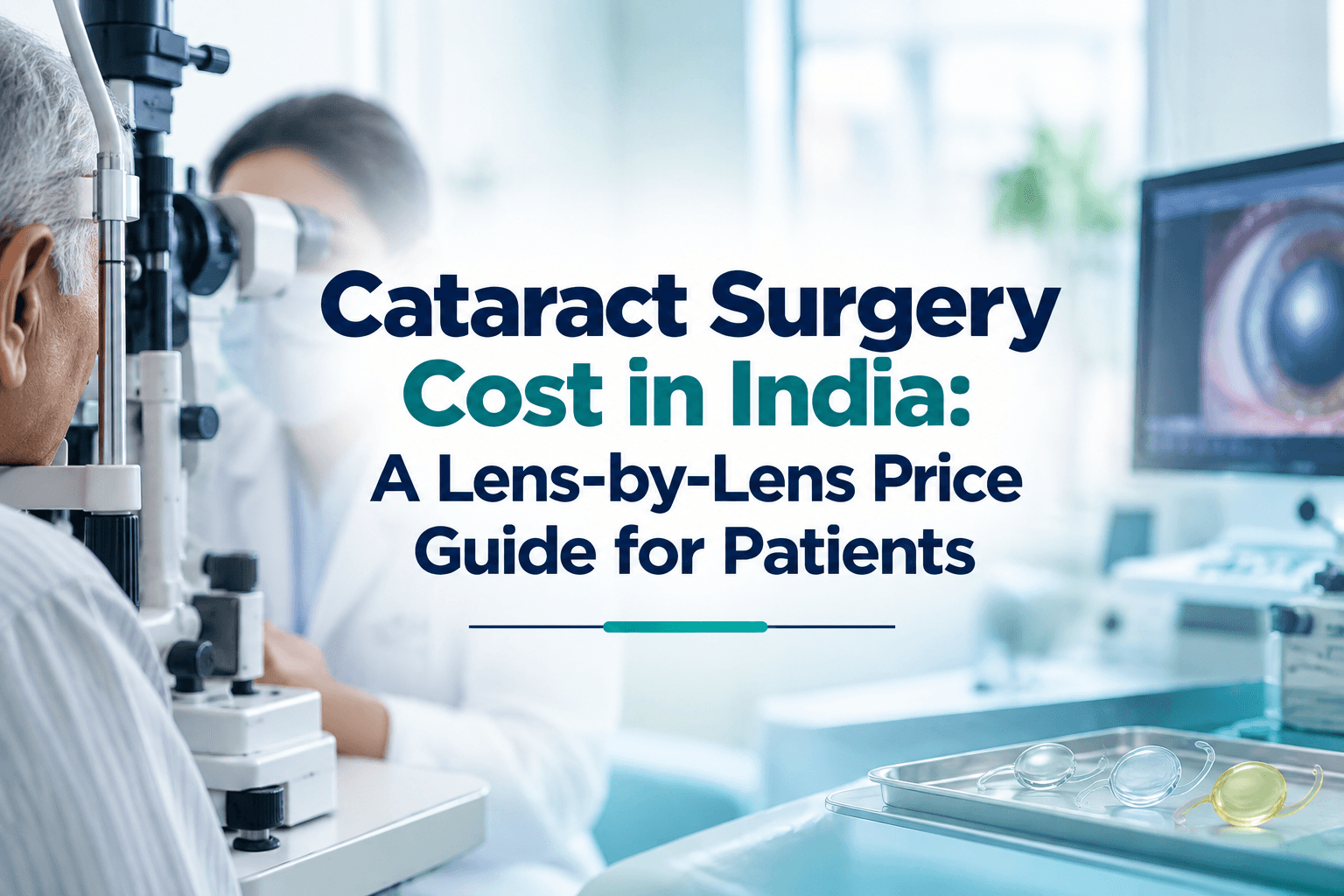
If an ophthalmologist has told you or a parent that it's time for surgery, you probably want a number before you want an explanation. Here it is: across India, cataract surgery cost usually falls somewhere between ₹15,000 and ₹1,60,000 per eye, and a small number of quotations go higher.
That spread looks absurd until you understand what sits behind it. A ₹20,000 quotation and a ₹1,20,000 quotation are often not the same operation with different profit margins. They can involve a different artificial lens, a different technique, a different level of pre-operative testing and a different hospital setup. The lens alone can account for more of the difference than the surgery itself.
This guide breaks the bill apart so you can read any hospital's estimate properly — and know which questions change the number.
All figures below are indicative. They are drawn from published Indian hospital and eye-care sources as of 2026 and are meant for planning, not as a quotation. Your actual cost depends on your eye, your city, your hospital and your lens.
The short answer, by procedure and lens
| Surgery / lens category | Indicative cost per eye | What moves the number |
|---|---|---|
| Manual small-incision surgery (MSICS/SICS) with a basic IOL | ₹8,000 – ₹35,000 | Hospital type, lens, scheme eligibility |
| Phacoemulsification with a standard monofocal IOL | ₹15,000 – ₹65,000 | City, hospital tier, surgeon, lens brand |
| Micro-incision cataract surgery (MICS) | ₹45,000 – ₹1,50,000 | Micro-compatible IOL, premium lens choice |
| Laser-assisted / femtosecond (FLACS) | ₹70,000 – ₹2,00,000 | Laser platform fee plus lens selected |
| Premium IOL upgrade (toric, multifocal, trifocal, EDOF) | Adds ₹30,000 – ₹1,00,000 | Lens family, brand, toric requirement |
Two things are worth noticing immediately.
First, the ranges overlap heavily. A well-equipped mid-sized eye hospital in a Tier-2 city may quote less for laser-assisted surgery than a large corporate hospital quotes for standard phaco. City and hospital categories matter as much as technology.
Second, published sources disagree. Some Indian eye hospitals quote phacoemulsification from around ₹15,000; others put the realistic floor closer to ₹25,000. Both can be accurate — one is quoting a high-volume centre using an Indian-manufactured monofocal lens, the other a metro hospital with imported lens inventory and a fuller diagnostic workup. Where you see a very low advertised price, the question to ask is not "is this real?" but "what lens and what tests are inside it?"
Why the lens decides most of your bill
Cataract surgery removes the eye's clouded natural lens and replaces it with an artificial intraocular lens (IOL). That implant is permanent, and it is where most of the price variation lives.
Published Indian lens prices span an enormous range — roughly ₹10,000 for a basic Indian-made monofocal to well over ₹1,00,000 for the newest premium optics. Broadly, four families exist.
Monofocal IOL. Focuses at a single distance, usually set for far vision. Monofocal IOLs remain a widely used option in India and deliver clear, predictable distance vision. People with a monofocal IOL set for distance will generally still need reading glasses for near work. Indicative lens cost: roughly ₹10,000–₹30,000 for Indian-made options, higher for imported and aspheric designs.
Toric IOL. Built to correct significant corneal astigmatism (a cylindrical number) at the same time as the cataract. It is not a lifestyle upgrade — it addresses a measurable corneal shape, and it only makes sense if your topography shows enough astigmatism to justify it. It requires extra pre-operative measurement and precise alignment during surgery. Indicative lens cost: roughly ₹28,000–₹45,000, more for toric versions of premium lenses.
Multifocal and trifocal IOL. These split or distribute light across two or three focal zones so that distance, intermediate and near vision are all usable. In suitable patients they can reduce dependence on glasses. They can also produce halos or glare around lights at night, particularly in the first months, and not everyone adapts equally. Indicative lens cost: roughly ₹40,000–₹1,10,000 depending on family and brand.
EDOF (extended depth of focus) IOL. Designed to stretch one elongated focal range rather than create separate zones, often with the aim of smoother intermediate vision and fewer night-vision artefacts than older multifocals. Indicative lens cost is wide — published Indian ranges run from about ₹30,000 to over ₹1,00,000 per lens.
Expensive does not mean better for you
This is the part most cost pages skip. A premium lens is not a superior version of a monofocal — it is a different trade-off. Multifocal optics distribute light, which can slightly reduce contrast; some patients notice this at night. Those with certain retinal conditions, corneal irregularity, advanced glaucoma or a strong professional need for night driving may be advised against them, and that advice is clinical, not commercial.
No lens should be sold to you as freedom from glasses, either. Premium IOLs may reduce spectacle dependence in suitable patients; they do not guarantee its elimination.
The right question is never "which lens is best?" It is "given my measurements and how I actually use my eyes, which lenses am I a candidate for — and what does each one cost here?"
What you are actually paying for
Ask for an itemised estimate and the single number becomes several. Understanding them makes two quotations comparable.
| Cost component | What it may include | Why it changes the bill |
|---|---|---|
| Surgeon / ophthalmologist fee | Surgical fee, sometimes pre-op consultation | Experience, sub-specialisation, complex-case handling |
| Hospital / day-care charges | Admission, day-care bed, nursing | Hospital tier, accreditation, city, room category chosen |
| Operation theatre charges | OT time, equipment, sterilisation | Whether a femtosecond laser or advanced phaco platform is used |
| Anaesthesia | Usually topical or local; sedation if needed | General anaesthesia (rare, e.g. some paediatric or anxious cases) costs more |
| Pre-operative evaluation | Vision testing, slit-lamp exam, dilated fundus check | Depth of workup; some centres bundle it, some bill separately |
| Diagnostic tests | Biometry (IOL power), keratometry, topography, OCT, specular microscopy, blood sugar/fitness tests | Premium and toric lenses need more precise measurement, so testing costs rise |
| IOL / lens | The implant itself | The largest single swing factor |
| Consumables | Viscoelastics, blades, sutures if required, drapes | Often "non-medical" in insurance terms and payable by you |
| Medicines | Post-operative drops, oral medication | Duration of drops varies by eye and surgeon protocol |
| Follow-up | Day-1, week-1, and later reviews | Number of included visits differs sharply between hospitals |
| Additional procedures | Managing a dense cataract, weak zonules, glaucoma or retinal issues found intra-operatively | Clinically driven, usually outside the base package |
The biometry line deserves attention. Measuring the eye accurately determines whether the implanted lens power lands on target, so centres investing in modern optical biometry and topography carry a higher cost base — and that cost is doing something real, particularly with toric or multifocal lenses, where measurement errors are less forgiving.
Technique: phaco, MICS, SICS and femtosecond laser
Phacoemulsification is widely used in Indian private eye hospitals. Ultrasound energy breaks the cloudy lens into fragments removed through a small self-sealing incision, and a foldable IOL is placed. It is day-care surgery, usually under topical or local anaesthesia, and most patients go home the same day.
MICS (micro-incision cataract surgery) is a refinement using an even smaller incision, which requires micro-compatible instruments and ultra-thin foldable lenses. Quoted ranges are higher partly because of instrumentation and partly because premium lenses are commonly paired with it.
MSICS / SICS uses a manual, slightly larger, sutureless incision. It is efficient, safe in trained hands, and remains widely used in high-volume and government settings — which is why the lowest published price bands cluster here.
FLACS (femtosecond laser-assisted cataract surgery) uses a laser to perform some steps — the corneal incision, the capsulotomy and initial lens fragmentation — before the surgeon completes the procedure. It commands a technology fee on top of the surgical and lens cost.
What the evidence actually says about laser
This is where cost pages tend to oversell, so it is worth being precise. Femtosecond laser cataract surgery is well established and safe. What the research has not shown is that it is automatically better for every patient.
A 2016 Cochrane review concluded that the available evidence was too limited to establish either equivalence or superiority against standard phacoemulsification, and called for large randomised trials. The UK's FACT trial, a multicentre randomised non-inferiority study of 785 patients funded by the National Institute for Health Research, was one response to that gap. Later pooled analyses have been mixed: a 2025 meta-analysis of 46 randomised trials covering 8,871 eyes found better corrected distance vision at one week after laser-assisted surgery, but no statistically significant difference beyond that point in corrected or uncorrected vision, spherical equivalent or surgically induced astigmatism. Safety-focused reviews have generally found comparable complication profiles between the two.
The practical reading: laser assistance offers precision advantages in specific situations — a very precise, reproducible capsulotomy matters more when implanting centration-sensitive premium lenses, for instance — and your surgeon is the person who can say whether your eye is one of those situations. Paying a laser surcharge for a routine cataract with a monofocal lens is a choice, not a requirement.
What a package usually covers, and what it may not
Package inclusions vary by hospital, technique and lens selected. There is no national standard. Still, most Indian cataract packages are built along these lines.
Usually included: surgeon's fee, operation theatre and day-care charges, topical or local anaesthesia, the standard IOL specified in the package, basic consumables, and a defined set of post-operative follow-up visits.
Frequently charged separately: the pre-operative diagnostic workup, any premium lens upgrade above the package lens, post-operative eye drops and medicines, non-medical consumables, treatment of coexisting eye conditions found during evaluation, additional intra-operative steps required by a complex cataract, extra follow-up beyond the included visits, a higher room category if you are admitted overnight, and surgery on the second eye.
Always ask for a written, itemised estimate that names the lens model, lists the tests included, states how many follow-up visits are covered, and specifies what happens to the price if the lens plan changes after biometry. A verbal quotation is not comparable to anything.
The second eye
Cataracts commonly develop in both eyes, though rarely at the same rate. When both need surgery, most Indian hospitals price them as two separate procedures, and second-eye discounts — where offered — are hospital policy rather than a rule.
Timing is a clinical decision. Many surgeons operate on the more affected eye first, review the outcome, and schedule the second eye after an interval, which also lets them refine the lens power calculation based on how the first eye settled. Budget for both from the beginning, but let your ophthalmologist drive the schedule, not a package deal.
Government hospitals and private hospitals
Cataract surgery is one of the highest-volume procedures in the Indian public health system. Under the National Programme for Control of Blindness and Visual Impairment, the Netra Jyoti Abhiyan campaign targeted 75 lakh cataract surgeries in FY 2022–23 and recorded over 83 lakh completed — a scale that puts government and NGO-supported eye care at the centre of India's cataract picture, not the margins of it.
| Factor | Government hospital | Private hospital |
|---|---|---|
| Cost | Free or heavily subsidised for eligible patients | Full package pricing |
| Waiting time | Often longer, depending on load | Usually shorter, scheduled |
| Lens options | Typically scheme-specified; premium lenses may need a top-up if available at all | Wider inventory generally available |
| Technology | Varies by institution; major centres are well equipped | Varies by hospital, not by price alone |
| Insurance / cashless | Depends on scheme eligibility | Depends on network and policy terms |
Neither column is the "better" one. Government tertiary eye centres and large charitable eye hospitals perform enormous volumes with published outcomes; surgical volume itself is associated with proficiency. What private hospitals typically offer is scheduling control, lens choice and continuity with a specific surgeon. Cost is a real difference. Quality is not something you can infer from the invoice.
Insurance and cashless treatment
The accurate statement is this: many health insurance policies may cover cataract surgery, subject to policy terms, waiting periods, sub-limits and insurer approval. Coverage eligibility is not the same as full reimbursement, and the gap between the two is where families get surprised.
Waiting periods. Cataract is almost always on the specific-illness waiting list. Twelve to twenty-four months is common in retail policies, and twenty-four months is the most frequently seen figure. If the cataract was already diagnosed before the policy started, it may be treated as a pre-existing condition, which carries a longer wait — capped at 36 months under IRDAI's 2024 rules. Corporate group policies often waive these waits entirely, which is why an employer plan is sometimes the more useful cover for a parent.
Sub-limits. Many policies cap cataract claims per eye, commonly in the ₹30,000–₹50,000 range, with ₹40,000 a frequently quoted figure. If your surgery costs more, the excess is yours. Newer no-sub-limit products cover cataract up to the full sum insured after the waiting period, but you must confirm this in writing.
Premium lenses and lasers. Insurers typically fund a standard lens. Upgrades to toric, multifocal, trifocal or EDOF lenses, and technology surcharges such as a femtosecond laser fee, are frequently excluded or partially payable. Consumables — kits, gloves, drapes — are usually classified as non-payable unless your plan specifically covers them.
Where to check. IRDAI now requires insurers to issue a one-page Customer Information Sheet listing sub-limits and waiting periods in plain terms. Read that before you read the policy wording.
Cashless. Traditionally cashless treatment worked only at your insurer's network hospitals, with pre-authorisation obtained before admission. In January 2024 the General Insurance Council launched Cashless Everywhere, extending cashless facility in principle to non-network hospitals registered under the Clinical Establishment Act with at least 15 beds, provided the claim is admissible under the policy and the insurer's operating guidelines. Per the Council's own launch terms, elective procedures must be intimated to the insurer at least 48 hours before admission, and emergencies within 48 hours of admission. Separately, IRDAI's May 2024 master circular requires insurers to decide cashless pre-authorisation within one hour of a complete request, and to clear final authorisation at discharge within three hours — which matters for a day-care procedure where you expect to go home the same day.
Cataract surgery is elective and scheduled, so the 48-hour notice is entirely within your control — but this is an industry initiative rather than a regulation, and implementation still varies by insurer and hospital. Confirm with your insurer for your specific hospital rather than assuming it applies.
Ayushman Bharat and government schemes
Cataract surgery is among the most claimed procedures in India's public insurance system. Analysis of PM-JAY data for 2018–2022 found that more than 98% of ophthalmology reimbursements went to cataract procedures.
Ayushman Bharat PM-JAY provides cover of up to ₹5 lakh per family per year for secondary and tertiary care on a family-floater basis, with no cap on family size or age and pre-existing conditions covered from day one. Treatment is cashless at empanelled public and private hospitals and is portable across states. Payment runs against defined Health Benefit Packages; the HBP 2022 master introduced tiered pricing by city tier.
Three cautions matter more than any number:
Eligibility is specific. PM-JAY entitlement is determined by defined criteria, and separate categories exist (including cover for senior citizens under later expansions). Not every family qualifies, and eligibility must be verified — not assumed.
Empanelment is specific. All government hospitals are empanelled by default; private hospitals are not. A hospital being large or well known says nothing about whether it can bill your surgery under PM-JAY.
Package rates change. HBP rates are revised periodically, differ by city tier, and states running their own schemes (or state-branded top-ups) may apply different rates and rules. Premium lenses and laser technology generally sit outside package scope and may require you to pay the difference where the hospital permits it.
For current eligibility and package details, verify at the official PM-JAY portal (pmjay.gov.in) or your State Health Agency rather than relying on any third-party rate list, including this one. Central schemes such as CGHS and ESIC maintain their own separate cataract rates and referral rules for their beneficiaries.
How to compare two cataract surgery quotations
Most patients compare the wrong thing — the headline number. Compare these instead.
- Is the lens named? Not "premium lens" but the actual model. Two multifocal lenses can differ by ₹40,000. If the estimate doesn't name it, the estimate isn't finished.
- Are the same tests inside both? If Hospital A includes biometry, topography and OCT and Hospital B bills them separately, the ₹6,000 gap between their quotations may not exist at all.
- How many follow-ups are covered? Cataract care runs for weeks after surgery. Three included visits versus one is a real difference.
- Are drops included? Post-operative medication typically runs several weeks.
- Does the technique justify its surcharge? If one quotation is higher purely because of a laser fee, ask the surgeon what the laser is doing for your particular eye.
- What is the escalation clause? If biometry changes the lens plan, or the cataract turns out denser than expected, what changes in the price?
- Which number does insurance see? A cheaper package with a premium lens billed separately may leave you with a larger out-of-pocket share than a higher package with the lens inside it.
- Is it for one eye or two? Confirm, in writing.
Questions worth asking before you fix a date
- Based on my biometry and corneal measurements, which lens types am I actually a candidate for — and which am I not?
- What is the price of this surgery with a standard monofocal lens, so I have a baseline?
- Is laser assistance clinically indicated in my case, or is it optional here?
- What do you expect my glasses dependence to be after surgery, honestly?
- Which items in this estimate are likely to be non-payable by my insurer?
- Who performs the surgery, and who sees me at follow-up?
- What happens, and what does it cost, if a complication needs additional treatment?
- Is the hospital NABH-accredited, and is it in my insurer's network?
How Aarogyam Surgicare fits in
Aarogyam Surgicare is a surgical care coordination platform — not the hospital that performs your surgery. We work with verified ophthalmologists and NABH-accredited partner hospitals, and our role is to make the cost picture legible before you commit to it.
That means an itemised estimate that names the lens rather than a headline figure, a Care Coordinator who stays with the case through admission and follow-up, help with insurance pre-authorisation and cashless paperwork, and guidance on whether a government scheme route may apply to your situation.
It also means we don't push premium lenses or laser technology because they cost more. If a monofocal lens with standard phacoemulsification is appropriate for your eye, that is what the estimate should reflect.
Get a personalised, transparent cataract surgery cost estimate.
Frequently asked questions
How much does cataract surgery cost in India?
Indicatively, ₹15,000 to ₹1,60,000 per eye, with some laser-plus-premium-lens quotations running higher. Standard phacoemulsification with a monofocal lens sits at the lower end; laser-assisted surgery with a trifocal or EDOF lens sits at the top. Your city, hospital category and lens choice determine where you land.
What does the cost of cataract surgery with an IOL include?
Typically the surgeon's fee, operation theatre and day-care charges, local anaesthesia, the package's specified lens, basic consumables and a set number of follow-up visits. Pre-operative tests, medicines, non-medical consumables and any premium lens upgrade are frequently billed separately. Inclusions vary by hospital, so ask for the itemised list.
Which lens is most expensive, and is it the best?
Trifocal and EDOF lenses, and toric versions of premium lenses, are generally the costliest — published Indian prices run past ₹1,00,000 per lens. More expensive does not mean better for you. Premium optics involve trade-offs such as possible halos or glare at night, and some eyes are not suitable candidates. Your ophthalmologist can determine which options fit your measurements and visual needs.
Is cataract surgery covered by health insurance?
Many policies may cover it as a day-care procedure, subject to terms. Expect a specific-illness waiting period — commonly 12 to 24 months — and check for a per-eye sub-limit, often in the ₹30,000–₹50,000 range. Premium lens upgrades and technology surcharges are frequently excluded. Your Customer Information Sheet lists these in one page.
Is cataract surgery covered under Ayushman Bharat?
Cataract procedures are included in the PM-JAY Health Benefit Package list and are among the scheme's most claimed surgeries. Whether you are covered depends on your family's eligibility and whether your chosen hospital is empanelled. Package rates vary by city tier and are revised periodically — verify current details at pmjay.gov.in or with your State Health Agency.
Is laser cataract surgery more expensive, and is it worth it?
Yes, it is more expensive — the femtosecond laser adds a technology fee to the surgical and lens cost. Whether it is worth it depends on your eye. Randomised evidence has not established that laser assistance produces better long-term visual outcomes than standard phacoemulsification for routine cases, though its precision can matter for certain lens choices and eye conditions. Ask your surgeon what it would change in your specific case.
Does cataract surgery cost less in a government hospital?
Usually yes, and for eligible patients it may be free or nominally charged under government schemes. The trade-offs are typically waiting time and lens choice rather than surgical quality — major government eye centres perform very high volumes. If waiting is not clinically safe in your case, your ophthalmologist will say so.
Can both eyes be operated on together?
Both eyes can require surgery, and they are normally priced as separate procedures. Most surgeons in India operate one eye first and schedule the second after an interval, which also allows the lens power calculation for the second eye to be refined. The timing is a clinical decision for your ophthalmologist, not a budgeting one.
Why do two hospitals quote such different prices for the same surgery?
Usually because it isn't the same surgery. Differences in the lens model, the technique, the depth of pre-operative testing, the number of included follow-ups, hospital accreditation and city cost base can easily produce a two-fold or three-fold gap. Comparing itemised estimates rather than headline numbers makes the difference visible.
How do I get a personalised estimate?
You need a recent eye examination including biometry, since lens power and lens suitability drive the price. Share your diagnosis and reports, specify your city, and ask for a written estimate naming the lens, the tests included and the follow-up covered. Aarogyam Surgicare can coordinate this across verified surgeons and NABH-accredited partner hospitals.
A closing note
The most expensive mistake in cataract surgery is rarely choosing the wrong hospital. It is choosing a lens you didn't understand, at a price you couldn't itemise, because nobody explained the alternatives. India performs this operation at enormous scale and with very high success — you have room to ask questions before you decide.
Bring your reports, ask for the itemised estimate, and make the lens conversation a real one.
Sources consulted
- National Health Authority, Ayushman Bharat PM-JAY — scheme benefits and Health Benefit Package framework (pmjay.gov.in; HBP manual, nha.gov.in)
- Press Information Bureau, Ministry of Health and Family Welfare — NPCBVI and Netra Jyoti Abhiyan cataract surgery figures, FY 2022–23
- General Insurance Council — "Launch of Cashless Everywhere" press release, January 2024, for intimation timelines and eligibility conditions (gicouncil.in)
- IRDAI Master Circular on Health Insurance Business, ref IRDAI/HLT/CIR/PRO/84/5/2024, dated 29 May 2024 — waiting period caps, moratorium, Customer Information Sheet requirement, 1-hour cashless and 3-hour discharge authorisation timelines
- Cochrane review (2016) and FACT randomised non-inferiority trial — femtosecond laser-assisted versus standard phacoemulsification
- Meta-analysis of 46 randomised controlled trials (8,871 eyes), Scientific Reports, 2025 — FLACS versus conventional phacoemulsification outcomes
- IHOPE Journal of Ophthalmology — analysis of ophthalmology claims under PM-JAY, 2018–2022
- Published Indian hospital and eye-care cost pages, including Centre for Sight (page updated July 2026) and comparable eye-hospital providers, for indicative 2026 price ranges by technique and lens
Medical disclaimer: This article is for general information and cost planning. It is not medical advice, a diagnosis, or a treatment recommendation, and it does not replace consultation with a qualified ophthalmologist. Cost figures are indicative and subject to change.